
Learning how to read a birth chart is one of the most important steps in understanding astrology. A birth chart, also called a natal chart or Janam Kundali in Vedic astrology, is a map of the sky at the exact moment of birth. It shows where the Sun, Moon, planets, and zodiac signs were placed at that time. This chart is not only a symbolic diagram. It is the foundation of serious astrological interpretation.
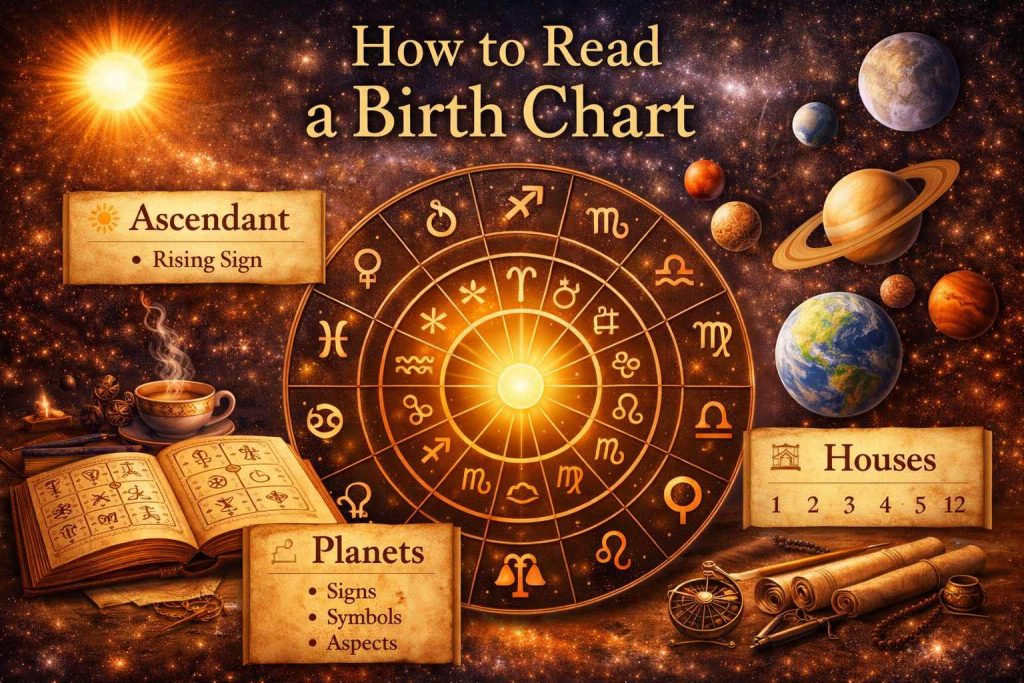
Many people first discover astrology through daily horoscopes, but those general readings only touch the surface. A birth chart goes much deeper. It reveals personality, emotional nature, strengths, weaknesses, life patterns, relationship style, career tendencies, and spiritual lessons. Once you understand how to read a birth chart, astrology starts to feel more personal, accurate, and meaningful.
At first, a birth chart can look confusing. There are houses, signs, planets, aspects, and many symbols that seem difficult to decode. However, the process becomes much easier when you follow it step by step. Reading a birth chart is not about memorizing everything at once. It is about learning how the different parts work together.
This guide explains how to read a birth chart in a simple and structured way. It is designed for beginners who want clarity, while still offering enough depth to be useful for serious readers.
What Is a Birth Chart
A birth chart is a snapshot of the heavens at the moment a person is born. It is calculated using three details: date of birth, time of birth, and place of birth. These details determine the exact positions of the planets and the rising sign at the eastern horizon.
Every birth chart is unique. Even twins born minutes apart can have slight chart differences. That is why astrology uses exact birth data instead of general sun sign categories alone.
When astrologers read a birth chart, they study the relationship between planets, houses, and zodiac signs. Each one represents a different layer of life. The planets show what energy is active. The signs show how that energy expresses itself. The houses show where that energy plays out in life.
This simple formula helps a lot when learning astrology. Planet means what. Sign means how. House means where.
Why Birth Chart Reading Matters
Reading a birth chart matters because it gives a personal view of astrology. Instead of broad predictions, it offers an individual map. It helps explain why one person is emotional and intuitive while another is practical and disciplined. It also shows why some people are naturally drawn toward leadership, creativity, healing, teaching, or business.
A birth chart can guide self-awareness. It can help people understand repeating patterns in relationships, career choices, emotional struggles, and life timing. It can also point toward areas of growth, natural talents, and internal conflicts.
For many people, astrology becomes more meaningful when they move beyond just reading their zodiac sign and begin learning how to read a birth chart properly.
The Main Parts of a Birth Chart
Before learning interpretation, it helps to understand the core building blocks of a chart. Every birth chart has three major elements: planets, signs, and houses. These are supported by aspects and planetary strength.
Planets
Planets represent core energies and functions in astrology. Each planet has a role.
The Sun shows identity, vitality, confidence, and purpose. The Moon shows emotions, instincts, and inner needs. Mercury relates to communication, thinking, and learning. Venus governs love, attraction, beauty, and pleasure. Mars rules action, courage, desire, and drive. Jupiter represents wisdom, growth, and blessings. Saturn governs discipline, karma, structure, and responsibility. Rahu and Ketu in Vedic astrology show karmic direction, obsessions, detachment, and life lessons.
When you look at a chart, the planets are the first layer of meaning.
Zodiac Signs
The zodiac signs show the style in which a planet operates. For example, Mars always represents energy and action, but Mars in Aries acts differently from Mars in Cancer. Aries may express Mars directly and boldly, while Cancer may express the same energy through emotional protection or indirect action.
Aries is bold and initiating. Taurus is stable and grounded. Gemini is curious and communicative. Cancer is emotional and nurturing. Leo is expressive and confident. Virgo is analytical and careful. Libra is balanced and relationship-oriented. Scorpio is intense and transformative. Sagittarius is expansive and philosophical. Capricorn is disciplined and ambitious. Aquarius is unconventional and visionary. Pisces is sensitive and spiritual.
The signs color the planets.
Houses
The houses show which area of life is influenced by the planet. There are twelve houses in a birth chart.
The first house relates to self, appearance, and personality. The second house relates to money, family, and speech. The third house governs communication, effort, courage, and siblings. The fourth house represents home, comfort, mother, and emotional roots. The fifth house is linked to creativity, romance, children, and intelligence. The sixth house relates to health, competition, debts, and service.
The seventh house governs marriage and partnerships. The eighth house shows transformation, hidden matters, and longevity. The ninth house relates to higher learning, spirituality, and fortune. The tenth house governs career, public image, and achievement. The eleventh house represents gains, networks, and ambitions. The twelfth house relates to loss, isolation, foreign lands, and spiritual liberation.
Once you understand the houses, chart reading becomes much clearer.
Step One: Start With the Ascendant
The best place to begin reading a birth chart is the ascendant, also called the rising sign or Lagna. This is the zodiac sign rising on the eastern horizon at the moment of birth. The ascendant sets the structure of the entire chart.
The ascendant reveals the outer personality, body, temperament, and approach to life. It also determines which sign falls in each house. Because of this, it is one of the most important parts of the chart.
If someone has Leo rising, they may appear confident, expressive, and noticeable. If someone has Virgo rising, they may come across as thoughtful, observant, and careful. The ascendant gives the first impression of the chart.
After identifying the rising sign, the next step is to study the ruler of that sign. This is called the chart ruler or Lagna lord. Its position shows how the person channels their life energy. For example, if the ascendant is Taurus, Venus becomes the chart ruler. If Venus is placed strongly, the person may have charm, taste, and relational strength. If it is under stress, those areas may need development.
Step Two: Study the Sun, Moon, and Ascendant Together
A good birth chart reading always gives special attention to the Sun, Moon, and ascendant. These three form the core identity triangle.
The ascendant shows how a person enters the world. The Sun shows conscious identity, purpose, and confidence. The Moon shows emotions, instincts, and the inner self.
For example, a person may have a bold Aries ascendant, a practical Virgo Sun, and a sensitive Cancer Moon. This combination can create someone who appears energetic and direct, thinks in a methodical way, but feels deeply and seeks emotional security.
Reading these three together gives a powerful first overview of the chart. It helps explain both outer behavior and inner experience.
Step Three: Look at Planetary Placements by Sign
After understanding the core identity, begin looking at each planet in its sign. Ask what each placement suggests about the person’s natural style.
Mercury in Gemini may suggest a quick and curious mind. Mercury in Capricorn may suggest serious and practical thinking. Venus in Libra may love beauty, harmony, and elegant relationships. Venus in Scorpio may love deeply and intensely. Mars in Leo may act with pride and drama. Mars in Virgo may act through precision, planning, and efficiency.
Each planet behaves differently depending on the sign it occupies. This is where astrology becomes layered and individual. Two people may both have strong Venus energy, but if one has Venus in Taurus and another has Venus in Aquarius, their love language and values may be very different.
Step Four: Check the House Placement of Each Planet
Once you know the sign, look at the house. The house shows where the planet’s energy will be most noticeable in life.
For example, Venus in the first house may make someone charming, attractive, or naturally diplomatic. Venus in the seventh house emphasizes love, marriage, and partnerships. Venus in the tenth house may support public appeal, artistic professions, or a graceful career image.
Mars in the third house may give courage and strong communication. Mars in the sixth house may support competition and determination in overcoming obstacles. Mars in the tenth house may show ambition and professional drive.
This is where the formula becomes useful again. Planet is what. Sign is how. House is where.
Step Five: Understand House Lords
One of the most important skills in birth chart reading is understanding house lords. Each house begins with a zodiac sign, and that sign has a planetary ruler. That ruler becomes the lord of the house.
For example, if the second house begins in Gemini, Mercury becomes the second house lord. Wherever Mercury is placed, it will influence money, family matters, and speech. If Mercury is in the tenth house, financial matters may connect strongly with career. If Mercury is in the fifth house, income may come through education, creativity, writing, or intellect.
House lords create links between different life areas. This makes chart reading more dynamic. Instead of reading houses in isolation, you begin to see how life themes connect with each other.
Step Six: Read Aspects Between Planets
Aspects are the angles planets make to one another. They show how different parts of the personality interact. Some aspects create flow, while others create tension or lessons.
A harmonious connection between Moon and Venus may show emotional warmth, affection, and artistic sensitivity. A tense connection between Mars and Saturn may create frustration, delay, or the need for disciplined effort. A connection between Mercury and Jupiter may support teaching, learning, and broad thinking.
In Vedic astrology, planetary aspects are studied with somewhat different rules than in Western astrology, but the central idea remains the same. Aspects show how planets influence one another.
This is an important step because planets do not operate alone. A strong Venus may still face challenges if it is closely influenced by Saturn, Mars, or Rahu. Likewise, a serious Saturn may become more optimistic if supported by Jupiter.
Step Seven: Notice Strong and Weak Planets
Not all planets operate with equal strength in a chart. Some are strong, comfortable, and capable of giving good results. Others may be weak, afflicted, or challenged.
A planet can gain strength through sign placement, house placement, dignity, and supportive aspects. It can lose strength through debilitation, affliction, or difficult house conditions.
A strong Jupiter may support wisdom, fortune, guidance, and morality. A weak Jupiter may create poor judgment, inconsistency, or lack of direction. A strong Moon often gives emotional balance and mental steadiness. A weak Moon may create mood fluctuations or insecurity.
When learning how to read a birth chart, always ask which planets seem most powerful and which seem stressed. This quickly reveals the chart’s main support system and its main lessons.
Step Eight: Focus on Repetition of Themes
One of the best ways to read a birth chart accurately is to look for repeated messages. If one life theme appears in many places, it becomes more important.
For example, if the tenth house is strong, the Sun is powerful, Saturn is well placed, and the chart ruler connects with career houses, then profession and public achievement are likely to be major life themes. If the Moon, fourth house, Venus, and seventh house are emphasized, emotional connection and relationships may dominate the person’s life story.
A single indication is not enough. Good chart reading looks for patterns repeated across planets, houses, and aspects. Repetition brings confidence to interpretation.
Step Nine: Read the Emotional Story of the Chart
A birth chart is not just a technical map. It also tells an emotional story. The Moon, fourth house, Venus, and water signs often reveal how a person feels, bonds, and seeks comfort.
If the Moon is placed in a stable sign and supported by benefics, the person may have emotional steadiness. If the Moon is under pressure from Saturn, Rahu, or Mars, emotional tension may be more visible. If Venus is strong, love and harmony may flow more easily. If Venus is afflicted, relationships may require maturity and healing.
Reading the emotional story helps astrology feel real and human. It explains why some people need security, some need freedom, some need recognition, and others need solitude.
Step Ten: Study Career, Love, and Life Purpose Separately
Once you understand the overall chart, begin reading specific life areas.
For career, study the tenth house, sixth house, second house, eleventh house, Sun, Saturn, Mercury, and Mars. For relationships, study the seventh house, Venus, Jupiter, Moon, and any aspects involving these. For creativity and children, look at the fifth house. For money, look at the second and eleventh houses. For spirituality, study the ninth and twelfth houses along with Jupiter and Ketu.
Breaking the chart into life themes makes interpretation more manageable. It also helps you answer focused questions more clearly.
Common Mistakes Beginners Make
One common mistake is reading only the Sun sign and ignoring the rest of the chart. Another is giving too much weight to one placement without checking the full context. For example, saying someone has a difficult love life just because Venus is in a challenging sign can be misleading if Venus is otherwise strong and well supported.
Another mistake is rushing. Birth chart reading is a process of synthesis. It takes patience to connect the planets, signs, houses, and aspects properly. It is better to read slowly and clearly than quickly and dramatically.
Some beginners also treat every difficult placement as negative. In reality, challenging placements often show growth areas, not fixed problems. Saturn may delay, but it also builds strength. Mars may create conflict, but it also gives courage. Rahu may create obsession, but it can also drive ambition and worldly success.
How to Practice Birth Chart Reading
The best way to improve is to practice on real charts. Start with your own chart. Learn your ascendant, Sun, Moon, and chart ruler. Then look at friends, family, or public figures. See how chart patterns match personality and life themes.
Write down observations. Compare what you see in the chart with real behavior, life experiences, and emotional patterns. Over time, this builds confidence and intuition.
Try reading one layer at a time. First practice signs. Then houses. Then planets. Then aspects. Then combinations. Astrology becomes easier when you build it gradually.
Birth Chart Reading in Vedic and Western Astrology
Both Vedic and Western astrology use birth charts, but they differ in technique and emphasis. Western astrology often focuses more on psychological interpretation, outer planets, and tropical zodiac calculations. Vedic astrology emphasizes karma, timing through dashas, house lords, yogas, and sidereal zodiac calculations.
Even though the systems differ, both agree on one essential idea. A birth chart is a personal map that reveals the structure of life, personality, and potential.
If you are learning from a Vedic perspective, pay extra attention to the Lagna, Moon sign, house lords, dashas, and yogas. If you are learning from a Western perspective, focus closely on planetary signs, aspects, and psychological themes. Either way, the principles of chart reading remain rooted in careful observation.
Conclusion
Learning how to read a birth chart is one of the most rewarding parts of astrology. It opens the door to a deeper understanding of personality, emotions, relationships, work, purpose, and life patterns. At first, the chart may seem complex, but once you understand the roles of planets, signs, houses, and aspects, the system becomes much clearer.
The best way to begin is simple. Start with the ascendant. Study the Sun and Moon. Look at each planet by sign and house. Notice the strongest patterns. Watch for repeated themes. Then slowly move toward deeper interpretation.
A birth chart is not just a prediction tool. It is a guide to self-awareness. It helps people understand who they are, what they carry, what they need, and where they may grow. When read with patience and wisdom, a birth chart becomes more than an astrological diagram. It becomes a meaningful mirror of life.