
Kaal Sarp Dosha is one of the most discussed and often misunderstood combinations in Vedic astrology. Many people hear this term and immediately feel fear, confusion, or anxiety. Some believe it brings constant struggle, delays, obstacles, and emotional stress. Others think it is a powerful karmic pattern that pushes a person toward growth, transformation, and spiritual awakening. Because of these mixed opinions, many people want to understand the real Kaal Sarp Dosha meaning in a simple and practical way.
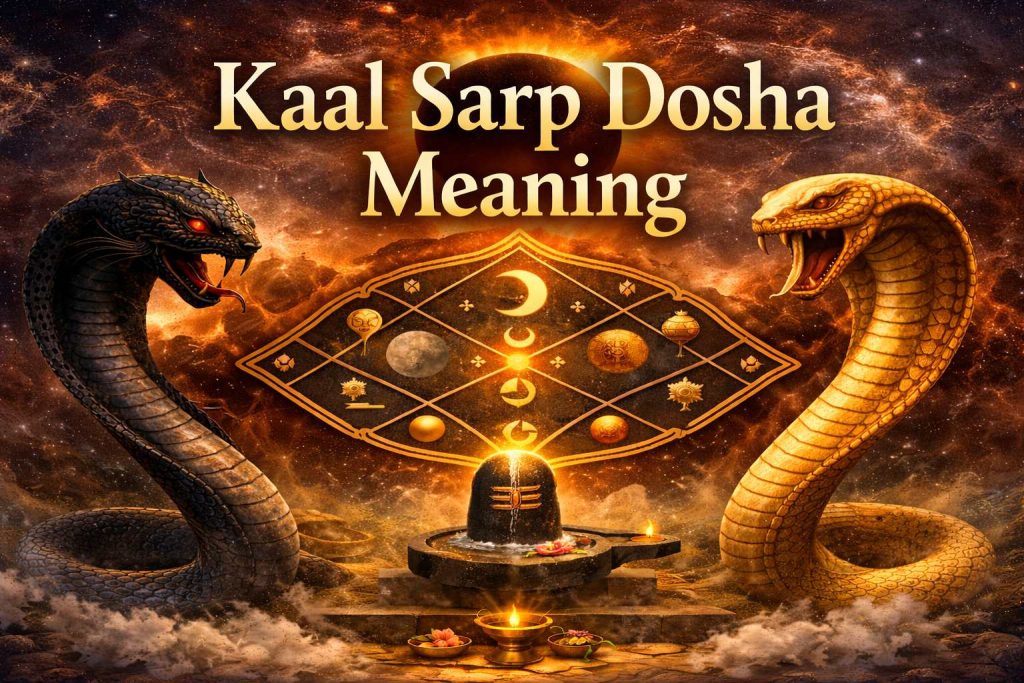
In Vedic astrology, Kaal Sarp Dosha is not just a phrase linked with worry. It is a planetary arrangement that is believed to show a special karmic influence in a person’s birth chart. The word “Kaal” is often connected with time, destiny, and deep karmic cycles. The word “Sarp” means serpent. Together, the phrase creates a symbolic image that reflects a life journey influenced by intense inner and outer experiences. This dosha is usually said to form when all the planets are placed between Rahu and Ketu in the horoscope.
However, understanding Kaal Sarp Dosha properly requires more than repeating common beliefs. A chart must be read carefully. The strength of the ascendant, the position of the Moon, the role of benefic planets, the overall planetary aspects, and the operating dashas all matter a great deal. One person with Kaal Sarp Dosha may face delays in marriage or career, while another may rise to great success after struggle. This is why a balanced understanding is important.
This article explains Kaal Sarp Dosha meaning in detail. It covers what it is, how it forms, why it matters, common life effects, myths, spiritual significance, and general remedies people follow in astrology. The goal is to help readers understand the topic in a calm, clear, and meaningful way.
The Dosha Discovery Quest
Is a hidden astrological Dosha affecting your progress? Answer these 5 intuitive questions to reveal your current cosmic alignment.
What Is Kaal Sarp Dosha in Vedic Astrology
Kaal Sarp Dosha is a planetary condition described in Vedic astrology when all seven major planets, namely Sun, Moon, Mars, Mercury, Jupiter, Venus, and Saturn, are placed within the axis of Rahu and Ketu. Rahu and Ketu are shadow planets, also known as lunar nodes. They are not physical planets, but they hold powerful astrological significance and are closely linked with karma, desires, illusions, past life influences, and spiritual growth.
When all the planets fall between Rahu and Ketu in the horoscope, astrologers say Kaal Sarp Dosha is formed. This arrangement is believed to create a tightening effect on the native’s life path. It may make the person feel as though life moves through pressure, repetition, intense mental patterns, and a constant push toward unresolved karmic lessons.
The meaning of Kaal Sarp Dosha is deeply symbolic. It suggests that the soul may be dealing with unfinished karmic patterns. It is often associated with sudden rises and falls, emotional instability, delays, hidden fears, restlessness, and strong ambition. At the same time, it can also give unusual focus, deep intuition, survival strength, and a strong urge to rise above circumstances.
Not every astrologer interprets Kaal Sarp Dosha in the same way. Some give it great importance, while others see it as one factor among many. A good astrologer always studies the whole chart before making conclusions. Kaal Sarp Dosha should not be treated as the single deciding factor of a person’s destiny.
Literal Meaning of Kaal Sarp Dosha
To understand the phrase more deeply, it is helpful to break the words apart. “Kaal” refers to time, fate, death, or the cosmic force that controls the rhythm of life. It can also represent the unavoidable movement of karma. “Sarp” means serpent, a symbol that appears often in Indian spiritual traditions. The serpent can represent hidden energy, fear, transformation, awakening, or karmic entanglement. “Dosha” means an imbalance or an affliction in astrological language.
So, the literal Kaal Sarp Dosha meaning can be understood as a karmic imbalance connected with time and serpent energy. Symbolically, it can suggest that the person feels trapped inside intense karmic cycles until certain lessons are learned. This is why many astrologers interpret it as a condition of inner struggle, outer challenge, and eventual transformation.
The serpent symbol is not always negative. In many traditions, the serpent also stands for wisdom, kundalini energy, protection, and deep spiritual power. Because of this, Kaal Sarp Dosha should not only be viewed as a curse. It can also be seen as a sign of intense life experience that shapes a person into someone stronger, wiser, and more aware.
How Kaal Sarp Dosha Is Formed
Kaal Sarp Dosha is formed when all the planets are placed on one side of the Rahu Ketu axis. Rahu and Ketu always sit opposite each other in the birth chart. If all seven planets are enclosed between them without any planet going outside the axis, this dosha is said to exist.
Some astrologers are very strict while checking this formation. They want all planets to be completely hemmed in between Rahu and Ketu. Others allow minor variations and still consider a partial form of Kaal Sarp Dosha. This is why the interpretation can vary from one astrologer to another.
There are also different types of Kaal Sarp Dosha based on the house positions of Rahu and Ketu. These forms are often given names such as Anant, Kulik, Vasuki, Shankhpal, Padma, Mahapadma, Takshak, Karkotak, Shankhachur, Ghatak, Vishdhar, and Sheshnag Kaal Sarp Dosha. Each type is believed to affect different parts of life depending on the houses involved.
For example, if Rahu is in the first house and Ketu in the seventh house, the effects may show strongly in personality, self-image, and relationships. If Rahu is in the tenth house and Ketu in the fourth, career and domestic life may become major areas of karmic tension. This is why house placement matters greatly in the final reading.
Why Kaal Sarp Dosha Is Considered Important
Kaal Sarp Dosha is considered important because Rahu and Ketu are powerful karmic points. Rahu represents obsession, worldly desire, ambition, confusion, hunger, and material attraction. Ketu represents detachment, past karma, spiritual lessons, isolation, and inner withdrawal. When all the planets fall between these two forces, life may feel controlled by a strong karmic current.
This dosha is often linked with the feeling that success comes late or only after repeated struggle. People with this combination may work hard but feel blocked at important moments. They may also experience mental restlessness, emotional extremes, family tension, career uncertainty, or a sense that life is never simple. Yet, these same people may eventually become extremely strong, determined, and spiritually evolved.
Astrologically, the importance of Kaal Sarp Dosha also comes from the role Rahu and Ketu play in eclipses. They are connected with shadow, illusion, sudden change, and destiny. When the planets are bound by this axis, the person’s life may carry a sense of pressure that forces them to confront their fears, desires, and weaknesses more directly than others.
Still, importance does not mean permanent misfortune. A powerful Jupiter, well-placed Moon, strong ascendant lord, or benefic aspects can reduce the intensity greatly. That is why complete chart analysis is necessary.
Common Effects of Kaal Sarp Dosha
The effects of Kaal Sarp Dosha can vary widely from person to person. Some may feel only a mild influence, while others may experience stronger life patterns. Much depends on planetary strength, house placement, dasha periods, and the overall chart balance.
One common effect linked with Kaal Sarp Dosha is delay. A person may find that important areas of life do not move smoothly. Education may face interruptions. Marriage may happen late. Career may start slowly. Financial stability may take time to build. Even when effort is sincere, results may seem delayed.
Another possible effect is mental unrest. The person may think deeply, worry often, or feel constant internal pressure. There may be a tendency to overanalyze situations or fear hidden obstacles. Sleep disturbances, emotional ups and downs, or recurring anxiety are also sometimes associated with this dosha, especially if the Moon is weak.
Relationship struggles may also appear in some charts. Misunderstandings, trust issues, distance, or karmic patterns in marriage and family life may develop. At the same time, such experiences often teach the person emotional maturity and deeper awareness of human nature.
Career life can be intense under Kaal Sarp Dosha. Some natives rise after prolonged struggle and gain success in surprising ways. The early phase of life may feel unstable, but later years can bring stronger recognition. This dosha is sometimes seen in charts of highly ambitious and influential people who face dramatic turning points before success.
Spiritual growth is another major theme. Many people with Kaal Sarp Dosha gradually become interested in prayer, meditation, astrology, mantra, or deeper self-understanding. After repeated life lessons, the native may move away from fear and toward inner strength.
Different Types of Kaal Sarp Dosha
Astrological tradition describes different forms of Kaal Sarp Dosha based on Rahu and Ketu placements. These types help astrologers understand which area of life may be more strongly affected.
Anant Kaal Sarp Dosha is linked with Rahu in the first house and Ketu in the seventh. It may influence self-image, health, confidence, and partnerships. Kulik Kaal Sarp Dosha is connected with the second and eighth house axis and may affect family peace, speech, finances, and sudden events. Vasuki Kaal Sarp Dosha relates to the third and ninth house axis and may involve courage, siblings, luck, beliefs, and father-related matters.
Shankhpal Kaal Sarp Dosha involves the fourth and tenth houses, often highlighting domestic life and profession. Padma Kaal Sarp Dosha affects the fifth and eleventh houses, touching education, children, intelligence, gains, and social circles. Mahapadma Kaal Sarp Dosha is formed on the sixth and twelfth axis and may connect with health, enemies, expenses, sleep, and spiritual detachment.
Takshak Kaal Sarp Dosha, Karkotak Kaal Sarp Dosha, and the other remaining types also follow this principle through different house axes. These names help classify the karmic focus, but interpretation should always be based on the actual chart rather than just the type name.
Kaal Sarp Dosha and Its Psychological Meaning
Beyond traditional astrology, Kaal Sarp Dosha can also be understood psychologically. It may reflect a mind that feels pulled between fear and desire. Rahu wants more. Ketu wants release. When the whole chart is enclosed within this axis, the person may constantly swing between worldly ambition and inner emptiness.
This can create a deep inner conflict. The person may chase success, approval, wealth, or recognition, yet still feel unsatisfied. They may want peace but find it difficult to detach from emotional patterns. This duality can create confusion early in life, but it can also lead to powerful self-discovery later on.
Many people with this dosha become highly resilient. They learn to function under pressure. They understand struggle more deeply than others. Over time, they often develop wisdom, maturity, and a strong sense of destiny. So, while Kaal Sarp Dosha may look difficult on the surface, it can also produce remarkable inner strength.
Myths and Misconceptions About Kaal Sarp Dosha
There are many myths surrounding Kaal Sarp Dosha. One of the biggest myths is that it ruins life completely. This is not true. No single combination can destroy a chart if strong positive factors are present. Many successful, respected, and powerful people are believed to have had this dosha in some form.
Another common myth is that Kaal Sarp Dosha means a person will never marry, never earn well, or always remain unhappy. Such statements are exaggerated and harmful. Astrology should guide, not create fear. A person’s life depends on the whole horoscope, their actions, timing cycles, and personal choices.
Some people also believe that expensive rituals alone can erase all effects. In reality, remedies in Vedic astrology are meant to support inner balance, faith, and karmic correction. They are not magical shortcuts. Right understanding, right action, discipline, spiritual practice, and patience matter just as much.
It is also important to know that partial forms of Kaal Sarp Dosha are often interpreted differently. Sometimes people are told they have the dosha without proper chart analysis. This creates unnecessary worry. A careful reading by a knowledgeable astrologer is always better than fear-based assumptions.
General Remedies for Kaal Sarp Dosha
In astrology, remedies for Kaal Sarp Dosha are usually spiritual and symbolic. They aim to calm the energies of Rahu and Ketu and strengthen inner balance. Remedies are not meant to create panic. They are meant to bring peace, faith, and clarity.
Many people worship Lord Shiva when dealing with Kaal Sarp Dosha because Shiva is deeply connected with serpent symbolism and karmic dissolution. Offering water or milk on Shivling, especially on Mondays, is a common spiritual practice. Chanting Maha Mrityunjaya Mantra is also widely recommended for peace, protection, and inner strength.
Some people recite Rahu and Ketu mantras or perform pujas connected with these shadow planets. Visiting sacred temples associated with serpent energy or Shiva worship is also considered beneficial by many. Charity, feeding the poor, helping animals, and practicing humility are traditional remedial actions believed to reduce karmic burden.
Fasting on specific days, maintaining purity of speech, avoiding harmful habits, and developing regular prayer can also help the person feel more centered. In many cases, the real remedy is not only ritual but transformation of conduct. Patience, emotional control, discipline, and spiritual focus often reduce the practical impact of this dosha over time.
Still, remedies should be selected with proper horoscope guidance. What suits one person may not suit another. A personalized approach is always better than blindly following general suggestions.
Can Kaal Sarp Dosha Be Canceled or Reduced
Yes, in many charts the effects of Kaal Sarp Dosha can be reduced, balanced, or modified. If strong benefic planets support the chart, the negative intensity may be much lower than expected. For example, a powerful Jupiter can give protection and wisdom. A strong Moon can support emotional balance. A well-placed ascendant lord can strengthen the person’s life path.
Benefic aspects on Rahu, Ketu, or key houses can also soften the dosha. Favorable dasha periods may bring stability, marriage, career success, and financial growth despite the presence of Kaal Sarp Dosha. In some cases, the person only feels the dosha more strongly during specific periods connected with Rahu, Ketu, or afflicted houses.
This is why astrology should never be reduced to one label. Kaal Sarp Dosha may be present, but its final result depends on the complete horoscope. Many people outgrow its stressful effects as they mature. Life may become much smoother after a certain age, especially if the person becomes more self-aware and spiritually grounded.
Spiritual Meaning of Kaal Sarp Dosha
On a deeper level, Kaal Sarp Dosha can be seen as a spiritual pattern rather than only a material affliction. It often indicates that the soul is passing through intense karmic lessons. The person may not be allowed an easy path because their life is meant to awaken deeper awareness.
This dosha can push a person to question life, fate, suffering, ambition, and the meaning of success. It may break ego patterns, remove false security, and force the native to discover inner truth. In this way, what first looks like difficulty may later become the doorway to wisdom.
Many spiritually inclined astrologers say that Kaal Sarp Dosha is not simply a punishment. It is a call for consciousness. It reminds the person that outer success alone cannot satisfy the soul. Real peace comes when karmic lessons are faced with maturity, prayer, right action, and self-understanding.
Conclusion
Kaal Sarp Dosha meaning is much deeper than fear-based astrology. It is a symbolic and karmic planetary condition in Vedic astrology where all planets are placed between Rahu and Ketu. This arrangement is believed to bring intensity, pressure, delay, emotional struggle, and karmic learning. Yet, it can also produce strength, ambition, resilience, intuition, and spiritual growth.
The presence of Kaal Sarp Dosha does not mean life is doomed. It does not guarantee failure, sorrow, or helplessness. Much depends on the overall horoscope, planetary strength, house placements, dasha timing, and the person’s own efforts. In many cases, the challenges linked with this dosha become the very reason a person grows wiser and stronger.
The best way to understand Kaal Sarp Dosha is with balance. Instead of fear, one should choose awareness. Instead of panic, one should choose right guidance. With proper chart analysis, spiritual remedies, patience, and disciplined living, the person can manage the effects and move toward a more stable and meaningful life.
In the end, astrology is not meant to frighten. It is meant to illuminate. Kaal Sarp Dosha is one such reminder that even difficult karmic patterns can become a path toward transformation, strength, and inner awakening.