
Marriage in Vedic astrology is not viewed only as a social or emotional bond. It is also seen as a sacred union of energies, values, family traditions, health patterns, and karmic connections. This is why horoscope matching, also known as kundli matching, remains an important step in many marriages. Among the different factors checked in kundli matching, Nadi Dosha is often considered one of the most serious. Many people hear this term during the match-making process and immediately become worried. Families may even reject a proposal only because of Nadi Dosha, sometimes without fully understanding what it actually means.
The truth is that Nadi Dosha is an important concept, but it should not be judged in isolation. Its real meaning, impact, and possible cancellation need careful interpretation by an experienced astrologer. In many cases, what people fear as a major obstacle may either be manageable or even nullified by stronger matching factors in the horoscope.
This article explains Nadi Dosha meaning in marriage in a clear and practical way. It covers what Nadi Dosha is, why it matters in kundli matching, how it is calculated, what its effects are believed to be, and when it may get cancelled. If you want to understand whether Nadi Dosha always creates problems in marriage or whether it can be balanced by other planetary combinations, this guide will help you see the subject more deeply.
💘 Nadi Compatibility Calculator
Select both Nakshatras to check for Nadi Dosha
What Is Nadi Dosha in Vedic Astrology
Nadi Dosha is a condition that arises during Ashtakoota Milan, the traditional eight-point system used to match horoscopes for marriage. In this system, a total of 36 points are considered. Nadi carries the highest weight among all the matching factors and contributes 8 points out of 36. Because of this high importance, astrologers pay special attention to it.
The word “Nadi” refers to the flow of energy or life force in the body. In astrology, it is linked with health, heredity, temperament, and compatibility at a subtle level. Nadi also reflects the balance of bodily constitutions and reproductive harmony between two individuals. When the bride and groom belong to the same Nadi, it is called Nadi Dosha.
According to traditional belief, the same Nadi in both horoscopes may indicate similarity in energetic patterns, which is not considered ideal for marriage. Astrology prefers complementary rather than identical Nadi combinations. This is why same Nadi matching is often seen as a dosha, or imbalance, in marriage compatibility.
Nadi Dosha is mostly checked on the basis of the Moon’s nakshatra. Since the Moon governs emotions, mind, instincts, and inner compatibility, its nakshatra becomes very important in marital matching. The idea is that emotional and biological harmony should exist between the couple for a stable and healthy marital life.
The Three Types of Nadi
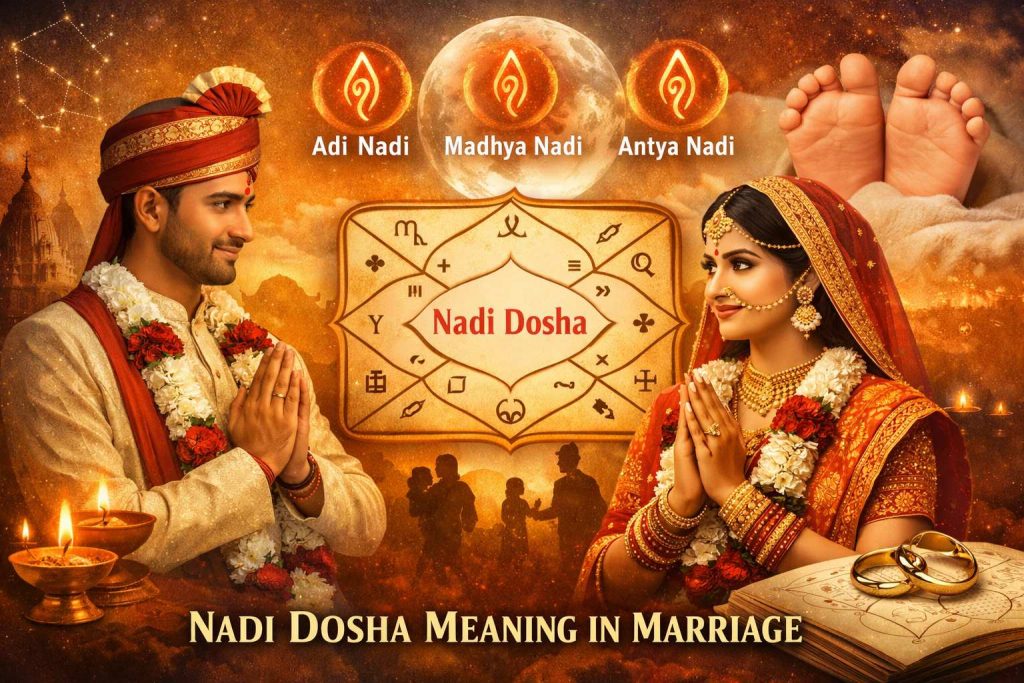
In Vedic astrology, all nakshatras are divided into three Nadis. These are known as Adi Nadi, Madhya Nadi, and Antya Nadi. Every person belongs to one of these three Nadis depending on their birth nakshatra.
Adi Nadi is associated with Vata nature. It is linked with movement, quickness, sensitivity, and mental activity. People under this Nadi may be energetic, thoughtful, and mentally active, but they may also be more restless or sensitive.
Madhya Nadi is associated with Pitta nature. It is connected with heat, passion, intensity, and ambition. Individuals under this Nadi may have strong willpower, leadership qualities, and determination, but sometimes they may also be more reactive or dominant.
Antya Nadi is associated with Kapha nature. It relates to stability, calmness, nurturing, and emotional depth. People under this Nadi may be patient, loyal, and grounded, though at times they may become overly attached or slow to adapt.
If both the bride and groom belong to the same Nadi, it creates Nadi Dosha. If they belong to different Nadis, the dosha is not formed and the full 8 points are usually awarded in Nadi matching.
Why Nadi Dosha Is Considered Important in Marriage
Nadi Dosha is considered important because marriage is not only about attraction or emotional bonding. In traditional astrology, it also concerns physical well-being, reproductive health, family continuity, and long-term adjustment. Nadi matching is believed to reveal whether the vital energies of two people will support or disturb each other.
One of the main reasons Nadi Dosha receives importance is its connection with progeny. Classical astrology often links this dosha with difficulties related to childbirth, children’s health, or family expansion. It is also believed to indicate health-related challenges or lack of harmony in certain cases. Because marriage in traditional Indian culture has long been tied to family life and lineage, Nadi matching became a serious consideration.
Another reason is that Nadi is assigned the highest score in Ashtakoota Milan. This suggests that ancient astrologers saw it as a crucial part of compatibility. While other factors like Gana, Yoni, and Bhakoot are also important, Nadi stands out because it is thought to touch the subtle level of bodily constitution and inherited patterns.
However, it is equally important to remember that the seriousness of Nadi Dosha depends on the complete horoscope. A single dosha should never be used to predict the entire future of a marriage.
How Nadi Dosha Is Calculated
Nadi Dosha is calculated using the birth nakshatra of both individuals. Each nakshatra belongs to one of the three Nadi groups. When the Moon in both horoscopes falls in nakshatras belonging to the same Nadi, Nadi Dosha is formed.
For example, if both individuals belong to Adi Nadi, or both belong to Madhya Nadi, or both belong to Antya Nadi, the match is considered to have Nadi Dosha. In such a case, zero points are awarded out of the 8 points assigned to Nadi in Ashtakoota matching.
If the bride and groom belong to different Nadis, the match receives the full 8 points for this category.
This seems simple on the surface, but real horoscope judgment is more complex. An astrologer may also examine the Moon sign, navamsa chart, strength of the seventh house, Jupiter, Venus, fifth house for progeny, and several other factors before making any final conclusion. That is why computerized matching reports can only provide a preliminary result. They cannot replace proper interpretation.
Does Nadi Dosha Always Create Problems in Marriage
This is one of the most important questions people ask, and the answer is no. Nadi Dosha does not always create problems in marriage.
Many people become afraid after seeing zero points in Nadi matching. Some even assume that the marriage will certainly fail or that the couple will face severe difficulties. This is an oversimplified understanding. In Vedic astrology, no single factor should be judged without context. The entire horoscope must be studied.
There are many marriages where Nadi Dosha is present, yet the couple lives happily. There are also cases where no Nadi Dosha exists, but the relationship still suffers because of other serious afflictions in the chart. This shows that marriage success depends on a broader combination of planetary influences, personal maturity, communication, family environment, and destiny.
Nadi Dosha should be taken seriously, but not blindly feared. The real question is whether the dosha is active and harmful in the context of the full horoscope, or whether it is cancelled or weakened by stronger positive factors.
Possible Effects of Nadi Dosha in Marriage
Traditional astrology associates Nadi Dosha with certain challenges, especially when it is strong and not cancelled. These effects should be understood as possibilities rather than fixed outcomes.
One possible concern is reduced compatibility in health and bodily constitution. Since Nadi relates to the flow of vital energy, same Nadi matching is believed to create an imbalance in natural harmony between partners. This may show up as stress, misunderstandings, or lack of comfort at a subtle level.
Another commonly discussed effect is delay or difficulty in childbirth. Classical texts often connect Nadi Dosha with issues related to progeny. This does not mean every couple with Nadi Dosha will face such problems, but this is one reason the dosha is treated with seriousness in traditional matching.
Some astrologers also associate it with emotional friction, lack of peace, or health concerns in married life. Again, such results depend on the overall horoscope. If the seventh house is strong, Venus and Jupiter are well placed, and the fifth house is supportive, the negative results may not manifest strongly.
Modern astrologers often advise that Nadi Dosha should be seen as one important indicator, not as a final judgment. Health, emotional compatibility, family values, and mutual respect are equally essential in real married life.
Nadi Dosha and Childbirth Concerns
The connection between Nadi Dosha and childbirth is one of the main reasons families worry about it. In traditional astrology, Nadi is linked with genetics, life force, and reproductive compatibility. When both partners belong to the same Nadi, it is believed that the natural flow needed for healthy progeny may be disturbed.
This belief has been passed down through generations, which is why Nadi matching is often treated seriously in arranged marriages. However, modern astrologers generally avoid making harsh or absolute statements based only on this factor. The fifth house, fifth lord, Jupiter, putrakaraka, Saptamsa chart, and overall health indicators must also be examined.
If these areas of the horoscope are strong, then the fear related to childbirth may be reduced. Many couples with Nadi Dosha become parents without major problems, while some couples without Nadi Dosha may still face delays due to other planetary reasons. Astrology works through combinations, not isolated formulas.
Therefore, when Nadi Dosha appears in a match, the right approach is deeper analysis rather than panic.
When Nadi Dosha Gets Cancelled
One of the most misunderstood aspects of horoscope matching is that people often believe Nadi Dosha can never be cancelled. In reality, there are several classical and practical conditions under which its negative impact may be reduced or nullified.
If the bride and groom have the same Nadi but different nakshatras with certain balancing conditions, astrologers may examine whether the dosha is truly active. In some traditions, if both partners are born in the same nakshatra but in different charanas, the dosha may not be considered equally harmful. In other situations, if the Moon signs are different and supportive, the effect may become milder.
Nadi Dosha may also be softened when the overall guna matching score is good and key marriage factors are strong. If the seventh house, seventh lord, Venus, Jupiter, and the fifth house are well placed, they can provide stability and reduce the practical impact of the dosha.
Some astrologers also consider cancellation when there is strong mutual attraction, supportive navamsa placements, and no major affliction to marriage-related houses. If the charts show emotional maturity, longevity of relationship, and healthy progeny indications, then Nadi Dosha may lose much of its feared importance.
This is why expert guidance matters. An experienced astrologer does not stop at the label of dosha. They look at whether the dosha is supported by the rest of the horoscope or neutralized by stronger positive combinations.
Difference Between Nadi Dosha and Other Doshas in Marriage
People often confuse Nadi Dosha with Manglik Dosha, Bhakoot Dosha, or other marriage-related concerns. Each dosha has a different meaning and should not be mixed together.
Manglik Dosha mainly relates to Mars and its influence on temperament, aggression, adjustment, and marital stability. Bhakoot Dosha is linked with Moon sign compatibility and financial or emotional harmony. Gana mismatch reflects differences in nature and temperament.
Nadi Dosha is different because it is more closely associated with health, subtle energy compatibility, and progeny. It does not automatically mean separation or conflict. Its domain is more connected with biological and energetic balance.
Since every dosha represents a different dimension of married life, astrology requires synthesis. A match with Nadi Dosha may still work well if the rest of the chart is supportive. Similarly, a match without Nadi Dosha may still face problems if severe afflictions exist elsewhere.
Should You Reject a Marriage Proposal Because of Nadi Dosha
This is a practical question, and the answer should be balanced. A marriage proposal should not be rejected only because a computerized report says Nadi Dosha is present.
Horoscope matching is a valuable tradition, but it must be used wisely. Many families rely only on the 36-point score and ignore the actual depth of chart analysis. This can lead to unnecessary fear or missed opportunities. Marriage is too important to judge only through one score.
If Nadi Dosha appears, the next step should be detailed consultation, not immediate rejection. The astrologer should examine cancellation factors, the strength of the marriage houses, the condition of Venus and Jupiter, health indications, and child-related combinations. The couple’s practical compatibility, values, communication, and family background should also be considered.
A wise approach respects astrology without turning it into superstition. Nadi Dosha is meaningful, but it is not the only truth in marriage matching.
Remedies for Nadi Dosha
In traditional practice, certain remedies are suggested when Nadi Dosha is present and judged to be significant. These remedies are meant to reduce the karmic and energetic imbalance indicated in the horoscope.
Remedies may include specific pujas, mantra chanting, daan, fasting, or rituals performed before marriage. Some astrologers may recommend Nadi Dosha Nivaran Puja or other Vedic remedies based on the full chart. In some cases, spiritual practices and blessings from elders are also considered important.
The value of remedies depends on faith, sincerity, and proper astrological guidance. Remedies should not be performed mechanically. They should be prescribed after checking the overall horoscope and understanding whether the dosha is actually strong enough to require correction.
It is also important to remember that remedies work best when accompanied by wisdom, patience, and practical understanding in the relationship. Astrology can guide, but human effort and mutual respect sustain marriage.
Modern View of Nadi Dosha in Marriage
In modern times, many astrologers take a more nuanced view of Nadi Dosha. They still respect its importance, but they do not treat it as an automatic sign of disaster. This is because experience has shown that marriage outcomes depend on many layers, including psychology, communication, family support, health, and destiny.
Today, responsible astrologers often combine classical matching with a broader reading of compatibility. They may study emotional bonding, timing of marriage, promise of relationship stability, fertility indicators, and even individual dasha periods. This creates a more realistic picture.
Modern couples also expect astrology to guide rather than frighten them. They want clarity on whether a dosha is genuinely harmful, whether it is cancelled, and what can be done if there is concern. This approach is healthier than blindly accepting or rejecting proposals on fear alone.
Conclusion
Nadi Dosha meaning in marriage goes much deeper than a simple yes or no in kundli matching. It is a traditional astrological concept connected with energy compatibility, health patterns, and progeny. Because it carries 8 points in Ashtakoota Milan, it is considered highly important. When both partners belong to the same Nadi, Nadi Dosha is formed, and classical astrology treats it seriously.
At the same time, Nadi Dosha should never be judged in isolation. It does not always create problems, and in many cases it may be cancelled, weakened, or balanced by stronger positive factors in the horoscope. The full chart, including the seventh house, fifth house, Venus, Jupiter, Moon, and navamsa, must be examined before drawing conclusions.
The most sensible approach is neither blind fear nor complete dismissal. Nadi Dosha deserves respect, but it also requires proper interpretation. A good astrologer looks beyond the label and studies whether the dosha is active, whether it is cancelled, and whether the marriage has broader signs of harmony and stability.
If you are considering marriage and Nadi Dosha appears in horoscope matching, do not panic. Seek detailed analysis, understand the real picture, and make decisions with both wisdom and balance. Marriage is a sacred journey, and astrology should help illuminate that path, not cloud it with unnecessary fear.