
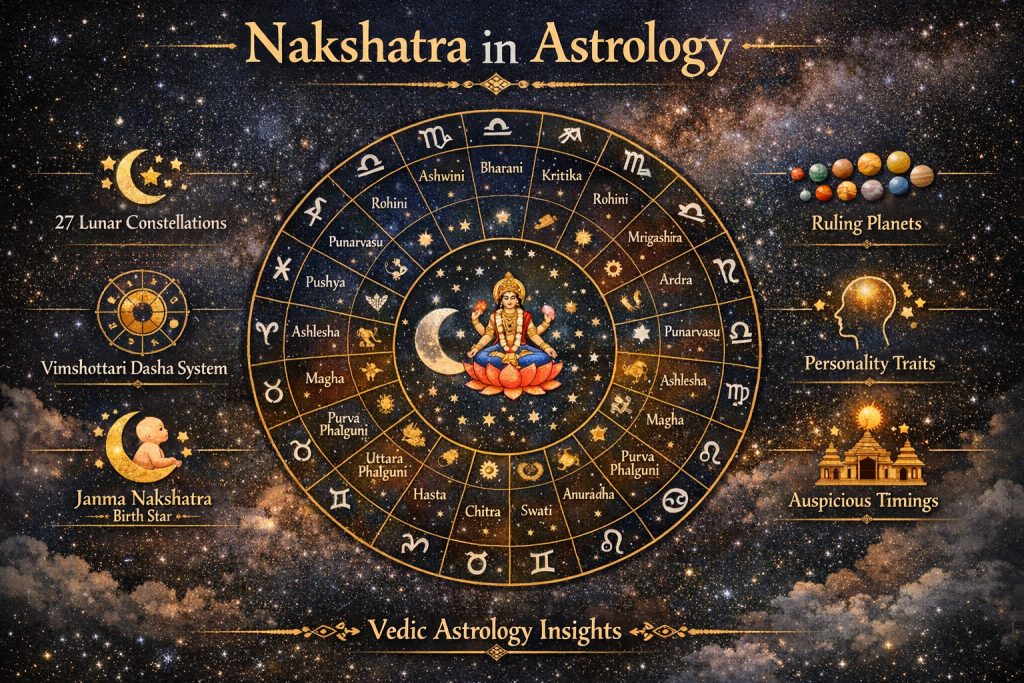
Nakshatra in astrology is one of the most fascinating and important concepts in the ancient system of Vedic astrology. While many people are familiar with the twelve zodiac signs, fewer understand the deeper level of analysis that comes from studying Nakshatras. In Vedic astrology, the zodiac is divided not only into twelve signs but also into twenty-seven lunar constellations known as Nakshatras. These Nakshatras provide a more detailed and precise understanding of human personality, emotional tendencies, and life destiny.
The Moon moves through these Nakshatras during its monthly cycle, spending approximately one day in each constellation. Because the Moon represents the mind and emotions, the Nakshatra in which the Moon is placed at the time of birth becomes extremely important in interpreting a birth chart. This lunar constellation reveals deeper psychological patterns, natural talents, and karmic influences that shape a person’s life journey.
Nakshatras have been used in Indian astrology for thousands of years to analyze personality, determine auspicious timings, and guide important life decisions such as marriage, career choices, and spiritual practices. Understanding Nakshatra in astrology can therefore offer profound insights into both the inner world and the external life path of an individual.
This article explores the meaning of Nakshatras, their role in Vedic astrology, the characteristics of the twenty-seven lunar constellations, and how they influence personality and destiny.
What Is Nakshatra in Astrology ?
Nakshatra in astrology refers to one of the twenty-seven divisions of the zodiac used in Vedic astrology. Each Nakshatra represents a specific group of stars or a lunar mansion through which the Moon travels during its monthly orbit around the Earth.
The entire zodiac covers 360 degrees, and in the Nakshatra system this circle is divided into twenty-seven equal parts. Each Nakshatra occupies 13 degrees and 20 minutes of the zodiac.
When a person is born, the position of the Moon in a particular Nakshatra becomes their birth Nakshatra, also called the Janma Nakshatra. This Nakshatra plays a major role in determining personality traits, emotional tendencies, career inclinations, and life events.
Each Nakshatra has its own ruling planet, symbol, deity, and set of characteristics. These factors combine to create a unique energetic influence that shapes the individual born under that Nakshatra.
In Vedic astrology, Nakshatras are considered even more precise than zodiac signs because they provide a deeper layer of analysis. While zodiac signs describe general personality traits, Nakshatras reveal subtle behavioral patterns and karmic influences.
Because of this precision, many astrologers rely heavily on Nakshatra analysis when interpreting birth charts and making predictions.
The Importance of Nakshatras in Vedic Astrology
Nakshatras play a central role in Vedic astrology because they connect cosmic movements with human psychology and destiny. The Moon’s placement in a Nakshatra reveals how a person thinks, feels, and reacts emotionally.
Astrologers often begin birth chart analysis by examining the Nakshatra of the Moon. This lunar constellation reflects the emotional nature and subconscious tendencies of the individual.
Nakshatras are also used to determine planetary periods known as dashas. The Vimshottari Dasha system, which is widely used in Vedic astrology, begins with the Nakshatra of the Moon at birth. This system helps astrologers predict important life events and major phases of personal growth.
In addition, Nakshatras are used to determine auspicious timings for important activities such as marriage ceremonies, business launches, travel, and religious rituals. Certain Nakshatras are considered favorable for specific types of activities, while others may be avoided for major decisions.
Because of their influence on both personality and timing, Nakshatras form an essential part of the predictive techniques used in Vedic astrology.
Structure of the Nakshatra System
The Nakshatra system divides the zodiac into twenty-seven equal segments. Each segment corresponds to a lunar mansion through which the Moon passes during its orbit.
Each Nakshatra has four smaller divisions known as padas. These padas connect the Nakshatra system with the twelve zodiac signs and provide even more detailed insights into personality and life events.
Every Nakshatra is also associated with a ruling planet according to the Vimshottari Dasha system. These planetary rulers influence the energy and characteristics of the Nakshatra.
The sequence of planetary rulers follows a repeating cycle that includes Ketu, Venus, Sun, Moon, Mars, Rahu, Jupiter, Saturn, and Mercury.
These planetary influences add another layer of meaning to Nakshatra analysis and help astrologers interpret the karmic patterns associated with each lunar constellation.
The 27 Nakshatras in Astrology
There are twenty-seven Nakshatras in Vedic astrology, each with unique qualities and symbolism.
Ashwini is associated with speed, healing, and new beginnings. People born under this Nakshatra are often energetic and pioneering.
Bharani represents transformation and responsibility. Individuals born in this Nakshatra often possess strong determination and inner strength.
Krittika symbolizes purification and courage. It is associated with leadership and strong willpower.
Rohini represents beauty, creativity, and growth. It is considered one of the most fertile and prosperous Nakshatras.
Mrigashira symbolizes curiosity and exploration. People born under this Nakshatra often seek knowledge and new experiences.
Ardra represents transformation and emotional intensity. It is associated with deep thinking and powerful emotions.
Punarvasu symbolizes renewal and optimism. Individuals under this Nakshatra often possess a positive outlook on life.
Pushya represents nourishment and spiritual wisdom. It is considered one of the most auspicious Nakshatras.
Ashlesha symbolizes mystery and psychological depth. People born under this Nakshatra often possess strong intuition.
Magha represents authority, tradition, and ancestral power. It is associated with leadership and respect for heritage.
Purva Phalguni symbolizes creativity, pleasure, and relationships.
Uttara Phalguni represents responsibility, stability, and generosity.
Hasta symbolizes skill, craftsmanship, and intelligence.
Chitra represents creativity, beauty, and artistic talent.
Swati symbolizes independence, flexibility, and adaptability.
Vishakha represents ambition and determination.
Anuradha symbolizes friendship, loyalty, and devotion.
Jyeshtha represents authority, protection, and leadership.
Mula symbolizes transformation and deep investigation.
Purva Ashadha represents enthusiasm and victory.
Uttara Ashadha symbolizes perseverance and long-term success.
Shravana represents learning, listening, and wisdom.
Dhanishta symbolizes prosperity, rhythm, and social success.
Shatabhisha represents healing, research, and innovation.
Purva Bhadrapada symbolizes spiritual intensity and philosophical thinking.
Uttara Bhadrapada represents stability, compassion, and wisdom.
Revati symbolizes kindness, prosperity, and spiritual protection.
Each of these Nakshatras contributes unique characteristics to individuals born under their influence.
Nakshatra and Personality Traits
Nakshatra in astrology plays a powerful role in shaping personality and emotional behavior. Because Nakshatras are closely connected to the Moon, they influence how individuals think, react, and interact with others.
For example, individuals born under Rohini Nakshatra often possess artistic talents and a love for beauty. Those born under Swati Nakshatra may value independence and freedom.
People born under Magha Nakshatra often display leadership qualities and respect for tradition. Individuals with Revati Nakshatra may possess compassion and strong spiritual awareness.
These characteristics influence career choices, relationships, communication style, and personal ambitions.
Because Nakshatras provide such detailed psychological insights, they are often used in compatibility analysis for marriage and partnerships.
Nakshatra and Auspicious Timing
Another important role of Nakshatras is determining auspicious timing for important activities. This practice is known as Muhurta in Vedic astrology.
Different Nakshatras are considered favorable for different types of activities. For example, Pushya Nakshatra is often considered highly auspicious for starting business ventures and religious activities.
Similarly, Rohini Nakshatra is associated with prosperity and growth, making it favorable for financial investments or creative projects.
By choosing favorable Nakshatra timings, individuals aim to align their actions with positive cosmic energies.
Conclusion
Nakshatra in astrology provides a deeper and more refined system of understanding human personality and destiny. By dividing the zodiac into twenty-seven lunar constellations, Vedic astrology offers a detailed framework for analyzing emotional patterns, talents, and karmic influences.
The Nakshatra of the Moon at birth reveals important insights into psychological tendencies and life direction. It also forms the foundation for predictive techniques such as planetary dashas and transit analysis.
Beyond personality interpretation, Nakshatras also guide auspicious timing for important events and decisions. This connection between cosmic rhythms and human life reflects the holistic nature of Vedic astrology.
As interest in astrology continues to expand globally, the study of Nakshatras remains one of the most powerful tools for gaining deeper insight into the mysteries of human destiny and the influence of celestial forces.