
Kundali is one of the most important concepts in astrology. It is a detailed birth chart prepared using a person’s date of birth, time of birth, and place of birth. In Vedic astrology, Kundali acts like a cosmic map that shows the position of planets at the exact moment of birth. Astrologers study this chart to understand personality, strengths, weaknesses, opportunities, challenges, and major life events.
Many people hear the word Kundali during discussions about marriage matching, career guidance, health predictions, financial timing, or spiritual growth. However, Kundali is much broader than a simple horoscope. It is the foundation of serious astrological analysis. A well-read Kundali can reveal patterns about education, relationships, profession, wealth, family life, mental tendencies, and even periods of progress or struggle.
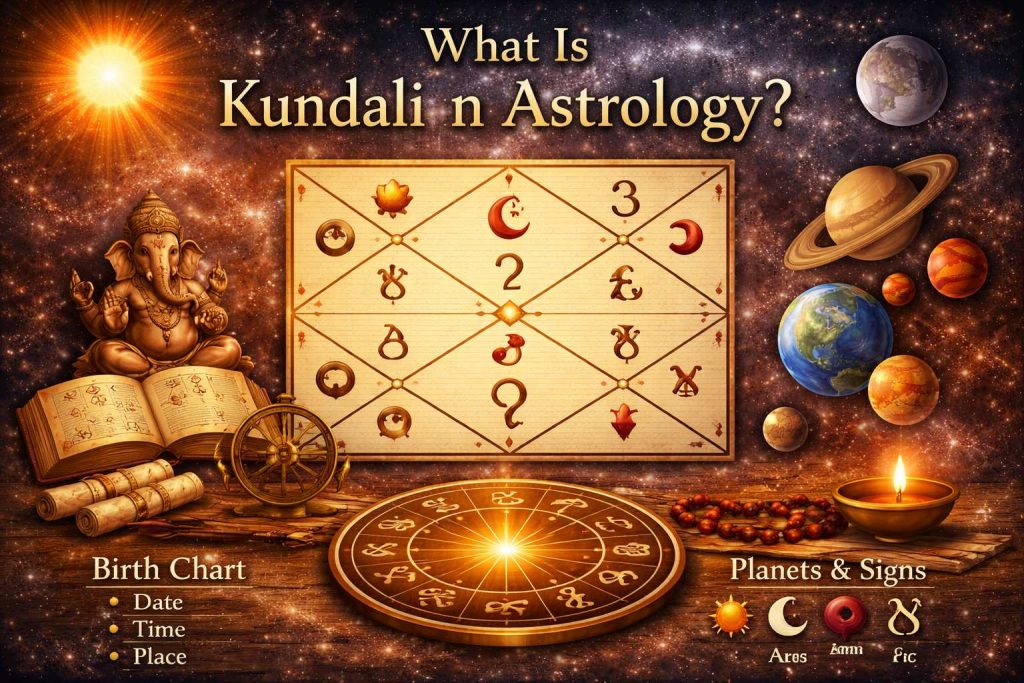
In modern times, Kundali has become more accessible through online tools and digital astrology platforms. Even so, the traditional meaning remains the same. It is a sacred astrological chart that connects earthly life with planetary movement. To understand astrology properly, one must first understand what Kundali is, how it is made, and why it matters.
Meaning of Kundali in Astrology
Kundali is often called a birth chart, natal chart, or Janam Kundali. In simple words, it is a snapshot of the sky at the exact time of birth. The Sun, Moon, planets, zodiac signs, and houses are all placed in specific positions in the Kundali. These placements create a unique astrological identity for every individual.
The word Kundali comes from Sanskrit and is linked with the idea of a circular or coiled pattern. In astrology, it reflects the arrangement of celestial energies that shape one’s life path. Since every person is born at a different moment and location, every Kundali is different.
A Kundali is not based on guesswork. It is calculated through astronomical and mathematical principles. The chart is then interpreted through astrological rules that have been studied for centuries. This is why Kundali holds such importance in Vedic astrology. It offers a structured method to understand human life through planetary influence.
Importance of Kundali in Vedic Astrology
Kundali is considered the backbone of Vedic astrology. Without Kundali, detailed astrological analysis is not possible. While daily horoscopes give general guidance based on zodiac signs, Kundali provides a personal and precise reading.
Astrologers use Kundali to study major areas of life. It helps them understand the native’s mental nature, family background, educational path, career direction, marriage prospects, financial growth, health tendencies, and spiritual journey. It also helps identify favorable and challenging time periods through planetary dashas and transits.
The importance of Kundali becomes especially clear during major life decisions. People often consult Kundali before marriage, business partnerships, property purchase, starting a new venture, naming a child, or choosing an auspicious date. In many Indian families, Kundali is seen not only as an astrological chart but also as a guide for planning life wisely.
How Kundali Is Created
A Kundali is created using three essential birth details. These are the date of birth, exact time of birth, and place of birth. Each of these details matters because even a small difference in time can change the ascendant and planetary positions.
The astrologer or software calculates the zodiac sign rising on the eastern horizon at the moment of birth. This becomes the Lagna or ascendant. After that, the positions of the Sun, Moon, and other planets are marked in different zodiac signs and houses. The final result is a structured chart that shows how the cosmic energies were aligned at birth.
Traditional astrologers used manual calculations based on panchang and ephemeris tables. Today, digital astrology software can prepare a Kundali within seconds. However, interpretation still requires knowledge and experience. A chart may be easy to generate, but reading it correctly is where real astrological skill begins.
Main Elements of a Kundali
A Kundali contains several important elements that work together. These include houses, zodiac signs, planets, ascendant, aspects, yogas, dashas, and divisional charts. Each element adds another layer of meaning.
The Twelve Houses in Kundali
The Kundali is divided into twelve houses. Each house represents a different part of life. The first house relates to self, body, personality, and overall life direction. The second house deals with wealth, family, food habits, and speech. The third house represents courage, communication, siblings, and effort.
The fourth house shows home, mother, property, comfort, and emotional peace. The fifth house governs education, intelligence, children, romance, and creativity. The sixth house is associated with enemies, health issues, debts, and competition.
The seventh house is the house of marriage, partnerships, and public dealings. The eighth house represents mystery, transformation, hidden matters, inheritance, and longevity. The ninth house is linked with luck, dharma, higher learning, and spiritual blessings. The tenth house shows profession, karma, status, and public image. The eleventh house indicates gains, ambitions, social circles, and fulfillment of desires. The twelfth house represents expenses, losses, foreign connections, isolation, and spiritual liberation.
The Zodiac Signs in Kundali
There are twelve zodiac signs in astrology, and each one carries a unique nature. These signs appear in the houses of the Kundali depending on the ascendant. Aries brings initiative and boldness. Taurus gives stability and practicality. Gemini supports communication and adaptability. Cancer adds emotion and nurturing energy.
Leo brings leadership and confidence. Virgo gives analysis and discipline. Libra supports balance and partnerships. Scorpio adds depth and intensity. Sagittarius gives wisdom and expansion. Capricorn supports responsibility and ambition. Aquarius brings innovation and broader thinking. Pisces adds sensitivity and spirituality.
The sign placed in each house influences how that area of life operates. This is why two people may both have strong career houses, but their professional style can still be very different depending on the signs and planets involved.
The Planets in Kundali
The planets are among the most important parts of Kundali reading. In Vedic astrology, each planet governs certain qualities and areas of life.
The Sun represents soul, confidence, authority, father, and leadership. The Moon represents mind, emotions, mother, and inner peace. Mars governs courage, energy, aggression, and action. Mercury rules speech, business, intellect, and communication. Jupiter represents wisdom, fortune, expansion, teachers, and blessings. Venus governs love, beauty, comfort, luxury, and relationships. Saturn represents discipline, delay, karma, hard work, and responsibility. Rahu and Ketu are shadow planets that represent karmic patterns, obsessions, detachment, and unusual life experiences.
The placement of these planets in signs and houses changes how they express their energy. A strong Jupiter may support wisdom and prosperity, while a weak or afflicted Jupiter may create confusion in judgment or delays in blessings. Every planet adds an important story to the Kundali.
What Is Lagna in Kundali
Lagna, also called the ascendant, is one of the most important points in a Kundali. It is the zodiac sign rising in the east at the time of birth. The entire house structure of the Kundali is based on the Lagna. Because of this, a change of even a few minutes in birth time can change the Lagna and the entire chart pattern.
Lagna reflects the physical body, outer personality, natural temperament, and general approach to life. It sets the tone for the whole Kundali. If the Lagna is strong and supported by benefic planets, the individual often handles life with confidence and resilience. If it is weak or afflicted, the person may face self-doubt, instability, or health-related concerns.
The lord of the Lagna is also highly important. Its strength, house position, and associations can reveal how easily a person progresses in life. This is why astrologers often begin Kundali interpretation by examining the ascendant and its ruler.
Role of the Moon Sign in Kundali
While the ascendant shows the outer self, the Moon sign shows the inner mind. In Vedic astrology, the Moon is extremely important because it governs emotional well-being, mental patterns, imagination, sensitivity, and daily experience.
A person may appear strong from the outside because of a powerful ascendant, yet may internally be sensitive or anxious due to the Moon’s condition. The Moon sign also plays a major role in dasha calculations, transit analysis, and compatibility matching.
Many traditional predictions are made from the Moon sign because it reflects how a person feels and responds to life events. A calm and strong Moon often brings emotional stability, while a disturbed Moon may create mood swings, stress, overthinking, or insecurity. Understanding the Moon in Kundali helps explain why people experience life so differently even in similar situations.
What Are Yogas in Kundali
Yogas are special planetary combinations in a Kundali. These combinations can create positive or negative results depending on the planets involved, their strength, and their placement. Yogas are one of the most fascinating parts of Kundali reading because they often explain exceptional abilities, success patterns, challenges, or karmic themes.
For example, certain combinations may create wealth yoga, career success yoga, intelligence yoga, leadership yoga, or spiritual yoga. At the same time, some combinations may show obstacles, delays, emotional turbulence, or sudden ups and downs.
A yoga does not work in isolation. Its result depends on the overall strength of the chart and the planetary periods active in life. A strong yoga may remain hidden until the right dasha activates it. This is why astrologers study both chart structure and timing before making conclusions.
Dashas and Timing in Kundali
Kundali does not only show what may happen. It also helps indicate when things are likely to happen. This timing system is called dasha. In Vedic astrology, dasha periods are based mainly on the Moon’s placement at birth.
Each dasha is ruled by a planet, and during its period, that planet becomes more active in the person’s life. If the ruling planet is strong and well-placed, the period may bring growth, success, relationships, wealth, or recognition. If the planet is weak or afflicted, the same period may bring stress, obstacles, illness, or emotional pressure.
Dashas are one of the reasons Kundali is so valuable. They provide timing, not just symbolism. An astrologer can study the dasha sequence and identify when marriage, career changes, travel, business expansion, or spiritual transformation may become prominent. This makes Kundali a practical tool for life planning.
Kundali and Marriage Matching
One of the most popular uses of Kundali is marriage matching. In traditional astrology, this is called Kundali Milan or horoscope matching. It is used to assess compatibility between two people before marriage.
Marriage matching studies several factors, including Moon sign compatibility, Guna Milan, Mangal Dosha, seventh house condition, Venus and Jupiter strength, and the dasha periods of both individuals. The purpose is to understand emotional harmony, family compatibility, physical attraction, mental understanding, and long-term stability.
Kundali matching does not simply decide whether a marriage should happen or not. A deeper reading helps identify strengths in the relationship and possible areas of adjustment. It can also suggest remedies if certain doshas or imbalances are present. When used wisely, Kundali matching becomes a helpful guide rather than a source of fear.
Kundali and Career Guidance
Kundali is also widely used for career analysis. The tenth house, sixth house, second house, eleventh house, and the planets connected with them are especially important in professional matters. The Sun, Saturn, Mercury, Mars, and Jupiter often play strong roles in determining career direction.
A person with strong Mercury may do well in communication, trade, writing, business, or technology. A strong Mars may support engineering, defense, surgery, or competitive fields. Jupiter may bless teaching, law, advisory roles, finance, or spiritual work. Venus may support design, beauty, luxury, media, or relationship-oriented professions. Saturn often favors structured, disciplined, long-term careers.
A good astrologer studies not only the profession itself but also the timing of career rise, job change, promotions, business opportunities, and setbacks. This is why many people consult Kundali when feeling uncertain about their career path or professional decisions.
Kundali and Financial Prospects
Financial analysis is another major area of Kundali interpretation. Wealth in astrology is not seen only from one house or one planet. The second house, eleventh house, fifth house, ninth house, and tenth house all play a role. Jupiter, Venus, Mercury, and sometimes Saturn or Rahu can influence financial success depending on the chart.
A strong second house may support savings and family wealth. A powerful eleventh house can bring gains and fulfillment of ambitions. A good fifth house may support intelligence in speculation or investments. The ninth house can show blessings and fortune, while the tenth house connects income with karma and professional effort.
Astrologers also look at the dasha and transit periods for financial growth. Even a strong wealth combination may not give full results unless activated at the right time. Similarly, difficult periods may require caution in business, investment, or spending. Kundali can therefore help in understanding both earning potential and money management patterns.
Kundali and Health Insights
Health is another important area seen in Kundali. The first house, sixth house, eighth house, and twelfth house often reveal health tendencies. The condition of the ascendant, its lord, the Moon, and certain planets can indicate both physical and mental well-being.
For example, a stressed Moon may show anxiety or emotional exhaustion. A troubled Mars may indicate injuries, inflammation, or anger-related strain. A weak Saturn can bring chronic issues, delays in recovery, or fatigue. Afflictions to the sixth or eighth house may suggest recurring health concerns that need attention.
Kundali does not replace medical advice, diagnosis, or treatment. However, it may show tendencies, vulnerable periods, and patterns that encourage preventive care and lifestyle awareness. In this way, Kundali can be used as a supportive and reflective tool for overall wellness.
Kundali and Spiritual Growth
Kundali is not only about material success. It also reveals the spiritual side of life. The ninth house, twelfth house, fifth house, Ketu, Jupiter, and the Moon often hold important clues about spiritual inclination.
Some people naturally feel drawn toward prayer, meditation, pilgrimage, mantra practice, service, or deeper self-inquiry. Their Kundali may show strong spiritual combinations or supportive placements in dharma houses. Others may come to spirituality after facing life struggles, which may be indicated through the eighth house or Ketu’s influence.
A spiritual reading of Kundali helps people understand their inner purpose, karmic lessons, and deeper calling. It reminds us that astrology is not only for prediction. It is also a path of self-awareness and alignment.
Types of Kundali Charts
In astrology, there is more than one type of Kundali chart used for analysis. The main birth chart is called the Rashi chart. This is the primary chart from which most life readings begin. However, astrologers also use divisional charts for more specific analysis.
The Navamsa chart is important for marriage, relationships, dharma, and inner strength of planets. The Dashamsa chart is often used for career and profession. Other divisional charts may be studied for children, property, spirituality, and different life themes.
A complete Kundali reading usually includes both the main chart and supportive divisional charts. These charts refine the interpretation and help confirm important patterns.
Can Kundali Predict the Future
This is one of the most common questions people ask. Kundali can indicate tendencies, probabilities, strengths, weaknesses, and timing patterns. It can show the kind of experiences a person is likely to face and when certain life themes may become active.
However, Kundali should not be understood as a rigid system that removes free will. Astrology shows the landscape, but human effort, awareness, decisions, and values also matter. Two people with similar chart patterns may respond very differently because of their choices and mindset.
So, Kundali is best used as a guiding instrument. As it helps people prepare, act wisely, and understand the meaning behind certain events. It does not exist to create fear. It exists to bring clarity.
Common Misunderstandings About Kundali
Many people think Kundali is only for marriage. This is not true. Marriage matching is just one use of Kundali. In reality, it can be used for almost every major life area.
Another misunderstanding is that Kundali is only about good and bad luck. In truth, it is about patterns, timing, karma, and potential. Every chart has strengths and challenges. The goal is not to label a person as lucky or unlucky, but to understand how to work with their planetary energies.
Some also believe that one dosha or one difficult placement ruins the whole chart. This is an oversimplification. Astrology is a complete system, and one factor must always be judged in the context of the full Kundali.
Why Kundali Still Matters Today
Even in today’s fast and digital world, Kundali remains relevant. People face confusion about relationships, career, money, purpose, and timing. Kundali offers a structured way to reflect on these areas. It helps individuals understand themselves at a deeper level.
Modern astrology platforms have made Kundali more available, but the timeless appeal comes from its depth. People do not just want surface-level advice. They want meaningful answers about who they are, what patterns they carry, and what direction suits them.
Kundali bridges tradition and modern life beautifully. It combines astronomy, symbolism, psychology, timing, and spiritual insight. That is why it continues to attract people across generations.
How to Read a Kundali Properly
Reading a Kundali properly requires knowledge, patience, and context. It is not enough to look at one planet or one house and make a quick conclusion. A good reading considers the ascendant, Moon sign, planetary strength, house rulership, aspects, conjunctions, yogas, dashas, transits, and divisional charts.
It is also important to understand the purpose of the reading. A marriage reading focuses on different factors than a career reading. A financial reading highlights different houses than a health reading. Interpretation becomes more accurate when it is both holistic and specific.
For beginners, it is helpful to first understand the houses, planets, and signs. From there, one can gradually learn how the combinations work together. The deeper the study, the more meaningful Kundali becomes.
Conclusion
Kundali is far more than a simple horoscope. It is a detailed astrological chart that captures the planetary positions at the time of birth and reveals the deeper structure of a person’s life. Through houses, signs, planets, yogas, dashas, and transits, Kundali helps explain personality, relationships, career, finances, health, and spiritual growth.
In Vedic astrology, Kundali remains one of the most trusted and powerful tools for self-understanding and life guidance. Whether someone seeks clarity about marriage, profession, wealth, or personal purpose, Kundali provides a framework to interpret these areas with depth and timing.
To understand astrology properly, one must begin with Kundali. It is the foundation on which meaningful prediction and self-awareness are built. When read wisely, Kundali does not create fear or limitation. Instead, it brings insight, direction, and a stronger connection with the rhythm of life.