
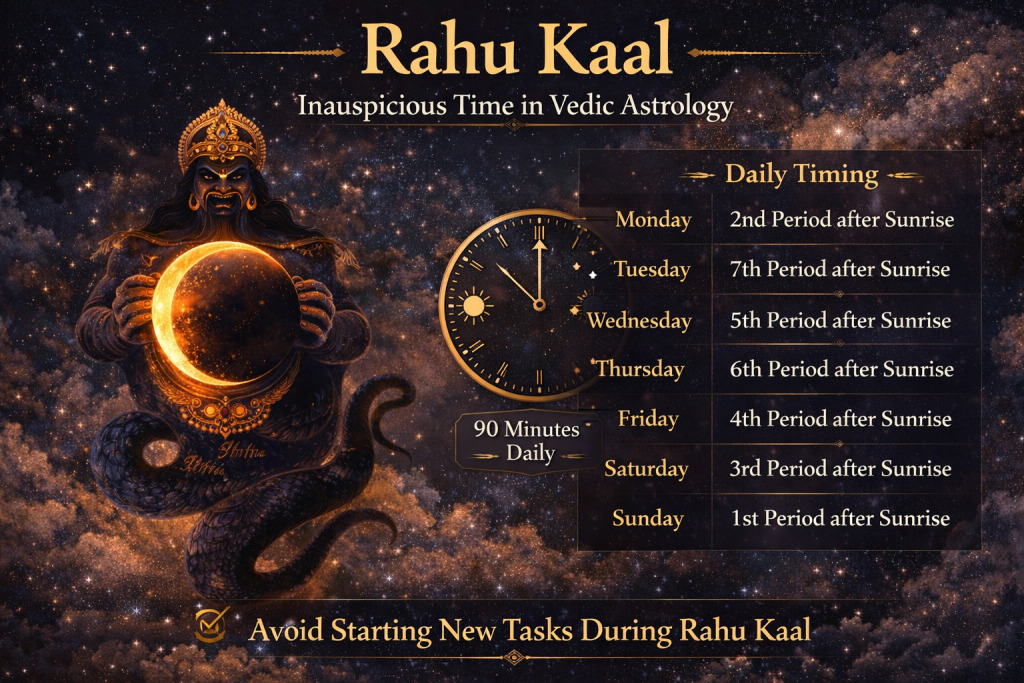
Rahu Kaal is an important concept in Vedic astrology that is widely followed in India when planning daily activities and auspicious events. Many people check Rahu Kaal before starting important tasks such as business deals, travel, investments, or religious ceremonies. According to traditional belief, Rahu Kaal is a specific period during the day that is considered inauspicious for beginning new activities.
The concept of Rahu Kaal originates from ancient Indian astrology and is closely associated with the shadow planet Rahu. In Vedic astrology, Rahu is not a physical planet but a mathematical point that represents the north node of the Moon. Despite not being a visible planet, Rahu is believed to have a powerful influence on human life, psychology, and destiny.
Rahu is often associated with illusion, confusion, sudden changes, and unexpected outcomes. Because of these qualities, the time period ruled by Rahu each day is considered unfavorable for starting new ventures. However, Rahu Kaal does not affect activities that are already in progress. It mainly influences the beginning of new actions.
Understanding Rahu Kaal helps individuals choose better timing for important tasks and avoid periods that may bring uncertainty or delays. Even in modern times, many people consult Rahu Kaal before scheduling important activities.
What Is Rahu Kaal ?
Rahu Kaal refers to a specific segment of time during the daytime that is ruled by Rahu. This period occurs every day and lasts approximately ninety minutes.
In Vedic astrology, the time between sunrise and sunset is divided into eight equal parts. One of these parts is assigned to Rahu, creating the daily Rahu Kaal.
Because Rahu is considered a malefic planetary influence in traditional astrology, this period is believed to be unsuitable for beginning important activities. Many astrologers advise avoiding major decisions, travel plans, financial investments, or ceremonies during Rahu Kaal.
However, routine daily activities such as work, study, or household tasks can continue normally during this time.
Why Rahu Kaal Is Considered Inauspicious
Rahu is known in astrology as a planet that creates illusions, confusion, and unexpected outcomes. Its energy is associated with unpredictability and sudden changes.
Because of this nature, starting a new task during Rahu Kaal is believed to increase the chances of delays, obstacles, or unfavorable results.
In ancient times, astrologers carefully observed planetary influences and noticed patterns in timing and outcomes. Over centuries, Rahu Kaal became widely accepted as a period to avoid when beginning important actions.
However, it is important to note that Rahu Kaal does not affect ongoing activities. If a task has already started before Rahu Kaal begins, it can continue without concern.
Daily Rahu Kaal Timings
The exact timing of Rahu Kaal changes every day because it depends on sunrise and sunset in a specific location. However, traditional astrology provides a standard weekday pattern that many people follow.
On Monday, Rahu Kaal generally occurs during the second segment of the day.
On Tuesday, it occurs during the seventh segment.
On Wednesday, it occurs during the fifth segment.
On Thursday, it occurs during the sixth segment.
On Friday, it occurs during the fourth segment.
On Saturday, it occurs during the third segment.
On Sunday, it occurs during the eighth segment.
Because sunrise times vary by location and season, the exact clock time of Rahu Kaal changes daily. Many people use Panchang calendars or astrology apps to check the precise timing.
Rahu Kaal in Daily Life
Even in modern society, Rahu Kaal remains an important part of traditional planning. Many people consult this period before making important decisions.
For example, individuals may avoid scheduling business meetings, signing contracts, launching projects, or beginning travel during Rahu Kaal.
Religious ceremonies and auspicious rituals are also often planned outside this time period.
However, normal daily tasks such as working, studying, cooking, or commuting are not restricted during Rahu Kaal.
The main purpose of observing Rahu Kaal is to choose a more favorable moment for starting important activities.
Rahu Kaal and Planetary Influence
In Vedic astrology, Rahu is associated with ambition, desire, illusion, and unconventional thinking. It represents material desires and sudden changes that can disrupt stability.
When Rahu influences a particular time period, astrologers believe it can create uncertainty or confusion. This is why Rahu Kaal is traditionally avoided for initiating important work.
However, Rahu can also bring innovation and unconventional success when its energy is properly understood. In modern astrology, some astrologers interpret Rahu as a force of transformation and technological advancement.
This perspective highlights that planetary influences are complex and can manifest differently depending on circumstances.
Rahu Kaal and Muhurta Selection
In Vedic astrology, choosing the right time to start an activity is known as Muhurta selection. Astrologers analyze planetary positions, lunar phases, and other factors to identify auspicious timings.
Rahu Kaal is one of the key elements considered during this process. Even if a day is considered favorable overall, astrologers may avoid scheduling important activities during Rahu Kaal.
By selecting an auspicious Muhurta outside Rahu Kaal, individuals aim to increase the chances of success and positive outcomes.
This tradition reflects the broader philosophy of aligning human actions with cosmic rhythms.
Modern Perspectives on Rahu Kaal
While Rahu Kaal remains an important concept in traditional astrology, modern interpretations vary. Some people follow it strictly when planning major events, while others consider it a symbolic reminder of timing and mindfulness.
In contemporary astrology, Rahu is often viewed as a force of ambition, innovation, and unconventional thinking. Rather than representing only negativity, Rahu may also inspire creativity and new ideas.
However, many individuals still prefer to avoid Rahu Kaal when starting important tasks as a precaution rooted in cultural tradition.
This balance between traditional belief and modern interpretation reflects the evolving nature of astrology in the modern world.
Conclusion
Rahu Kaal is a daily time period in Vedic astrology that is considered inauspicious for beginning new activities. It lasts approximately ninety minutes and occurs at different times each day depending on the position of the Sun.
The concept is based on the influence of Rahu, a shadow planet associated with illusion, unpredictability, and sudden change. Because of this influence, many people avoid starting important tasks during Rahu Kaal.
Despite being considered unfavorable for new beginnings, Rahu Kaal does not affect routine activities or tasks that are already in progress.
By understanding Rahu Kaal and its significance, individuals can make more informed decisions about timing important events and aligning their actions with traditional astrological guidance.
For many people, observing Rahu Kaal is not just about avoiding bad timing but about respecting the ancient wisdom of cosmic cycles that has been passed down through generations.